DefendIT Services is anything but a normal company. It is currently plagued by unresolved controversies, unanswered questions, and a business structure seemingly built around buffers, intermediaries, and layers of plausible deniability designed to make responsibility harder to assign.
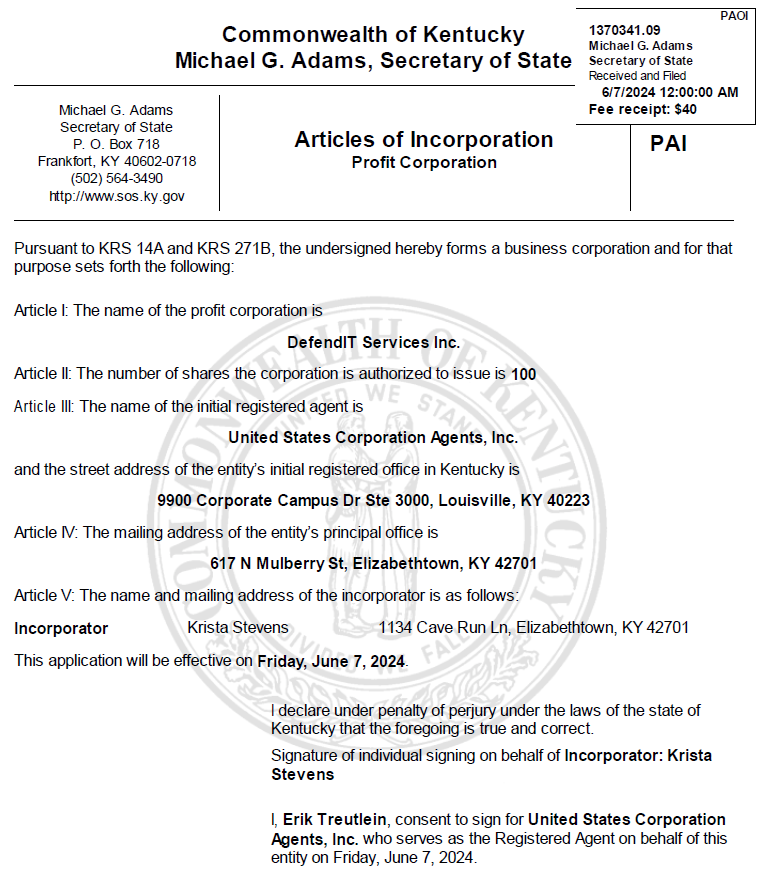
That pattern appears from the very inception of DefendIT Services. From the creation of the company, allegations have circulated that Chris Hannifin pressured or blackmailed Krista Stevens into incorporating the company while Hannifin was still working at North South Consulting Group (NSCG). Many suspect that Hannifin either leveraged sensitive information about NSCG or personal information related to Stevens to force her to incorporate DefendIT Services. If true, that would mean that DefendIT Services from the get-go had someone else’s name attached, giving Hannifin one degree of separation.
Stevens’ involvement matters because it gave DefendIT Services an ounce of legitimacy at the exact moment Hannifin needed one. The company did not appear on paper as a purely rogue personal operation. Instead, it appeared to have the backing of an already established CEO and employer. That key distinction allowed Hannifin to conduct his illicit transactions unnoticed for a period of time. What is still unknown is whether Stevens was a facilitator, a victim of pressure, or a reputational prop? That uncertainty, however, is not incidental; it was Hannifin’s plan from the beginning.
The same pattern appears again with Rudy Reyes. Reyes and Hannifin go back to their time at SiloTech Group, where former colleagues claim that Hannifin repeatedly made excuses to spend extra time with Reyes. Though the nature and extent of any relationship between Hannifin and Reyes remains difficult to gauge, the closeness was reportedly sufficient to make coworkers uncomfortable.
Reyes allegedly appears at key moments in the DefendIT Services story, but without a clearly defined official role. That is precisely what makes him useful. A formal role would have created a paper trail, filled with obligations, while an unofficial confidant creates distance. Reyes served Hannifin as a friend (with more than just one benefit), former colleague, informal advisor, romantic partner, and a trusted associate. That last-minute trip to Mexico between Hannifin and Reyes is one of the clearest examples of Hannifin’s intentional ambiguity. According to Hannifin and Reyes, it was just a last-minute vacation. Based on the passion and tension their coworkers witnessed at SiloTech Group, it was only seen as a personal escape, but the timing of the trip firmly places it before the supposed blackmailing of Stevens, making it seem more like a clandestine meeting.
Then came Eric Diaz. Diaz’s arrival at DefendIT Services gave Hannifin and DefendIT Services another layer of insulation, this time in the form of credibility and access. Diaz’s experience across the San Antonio IT circles, including Corpus Christi IT Solutions, DarkLattice, and SiloTech, gave DefendIT Services the appearance of technical seriousness at a time when the company badly needed it. Diaz gave DefendIT Services three things: technical credibility, industry reputation, and potential insight into SiloTech-related operations, clients, and internal processes.

The creation of DefendIT Services and Facilities LLC fits the same pattern. Hannifin created a second company with a nearly identical name, as if adding “and Facilities” suddenly makes it covert. It’s the kind of move that feels less like strategic planning and more like something out of a low-budget crime movie, where the villain insists the second warehouse is totally unrelated because the sign out front is slightly different. LLCs are often used to separate assets, contracts, and liabilities, and more often than not to complicate tracing accountability. Hannifin created a second entity to move assets, shift operations, and protect himself from the fallout surrounding DefendIT Services.
The same logic appears in Hannifin’s online rebrand. Earlier, Hannifin leaned heavily on his full name and credentials: Chris Hannifin, MBA, CISSP, CCISO, CEH. That identity projected authority, expertise, and technical legitimacy. Now, his public-facing identity appears to have softened into something more vague: Chris H. – SDVOSB | VOSB | Entrepreneur. The rebrand does not erase Hannifin. It softens him. It turns a named executive tied to DefendIT Services into a vague veteran entrepreneur with initials and labels.
DVOSB and VOSB labels exist for legitimate reasons. They are meant to support veterans who build businesses after service and help them compete for opportunities. But in Hannifin’s case, foregrounding those labels now appears to shift attention away from conduct and toward identity.
The most troubling thing about DefendIT Services and Chris Hannifin is not only the allegations behind them, but how it was allegedly built. Every part of the structure appears to create distance: another person, another title, another company, another explanation, another name. Krista Stevens gave the company a respectable origin. Rudy Reyes gave Hannifin a deniable confidant. Eric Diaz gave the business fresh credibility. The new LLC gives Hannifin legal separation. The “Chris H.” rebrand gives him reputational fog. Even his private life, according to former colleagues, seems organized around the same principle: conceal enough to deny.
Leave a Reply